- Yopitek Ltd/
- Products/
- SDRLAB Software-Defined Radio Modules/
- OpenSourceSDRLab RTL-SDR Blog V4 — Entry-Level SDR Receiver/
OpenSourceSDRLab RTL-SDR Blog V4 — Entry-Level SDR Receiver
The RTL-SDR Blog V4 is an entry-level USB software-defined radio receiver for hobbyists, amateur radio users and RF researchers. It covers 500 kHz–1.766 GHz with an R828D tuner, a built-in HF upconverter and a 1 PPM TCXO. Contact Yopitek for a quotation in Taiwan.
Features#
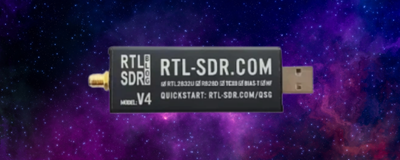
- R828D tuner with three inputs; a triplexer splits the SMA input into HF, VHF and UHF bands for better out-of-band isolation
- Built-in HF upconverter: HF is upconverted by 28.8 MHz, so no direct sampling mode is needed (lowest tuning limit 500 kHz)
- 1 PPM Temperature-Compensated Crystal Oscillator (TCXO) for significantly improved frequency stability
- Software-controlled Bias-Tee powers external LNAs or active antennas
- Switchable notch filter for the broadcast AM, broadcast FM and DAB bands reduces strong-station interference
- Conductive black metal enclosure that shields and doubles as a heatsink, plus USB noise choking and improved ESD protection
- Bundled multipurpose dipole antenna kit — ready to use right out of the box
Specifications#
| Specification | Value / Description |
|---|---|
| Tuner Chip | Rafael Micro R828D |
| ADC Chip | RTL2832U |
| Frequency Range | 500 kHz – 1.766 GHz (including HF mode) |
| Frequency Accuracy | 1 PPM TCXO |
| RF Connector | SMA |
| Bias-Tee | Software-enabled, max 4.5 V |
| HF Reception | Built-in upconverter (HF upconverted by 28.8 MHz; no direct sampling needed) |
| Enclosure | Conductive black metal enclosure (shield and heatsink) |
| Interface | USB (requires RTL-SDR Blog drivers) |
| OS Support | Windows, Linux, macOS, Android |
| Accessories | Dipole antenna kit (dipole base with 60 cm RG174 cable, 4× telescopic antennas (2× 23 cm–1 m, 2× 5–13 cm), 3 m RG174 extension cable, tripod, suction cup mount) |
Use Cases#
- ADS-B aircraft tracking
- Maritime AIS vessel monitoring
- NOAA / Meteor M2 weather satellite image reception
- Amateur radio (HF/VHF/UHF receive)
- Radio astronomy (hydrogen line observation)
- P25 and MotoTRBO digital voice decoding
- APRS and ACARS packet tracking
- DAB digital radio reception
- RF spectrum monitoring and security research
Frequently Asked Questions
Do I need direct sampling mode to receive HF on the RTL-SDR Blog V4?
No. According to RTL-SDR Blog, activating direct sampling mode on a V4 dongle yields no results. The built-in upconverter upconverts HF by 28.8 MHz, and the RTL-SDR Blog drivers handle the offset.
Does the RTL-SDR Blog V4 need special drivers?
Yes. The V4 requires the RTL-SDR Blog drivers, which are backward compatible with V3 and older units. Without them the V4 will not function correctly.
How does the bias tee on the RTL-SDR Blog V4 work?
The bias tee is software controlled and rated at 4.5 V, supplying up to 180 mA continuously. On Linux it is switched with rtl_biast, and it only works with the RTL-SDR Blog drivers.
What frequency range does the RTL-SDR Blog V4 cover?
It covers 500 kHz to 1.766 GHz. HF is upconverted by 28.8 MHz, the TCXO provides 1 PPM frequency accuracy, and the RF connector is SMA.
Setup guides and technical details — doc.yupitek.com
Related products
- SDRLab Flipper Zero 5G Add-On Board — Dual-Band Wi-Fi Security Research Module
- SDRLab Flipper Zero Ethernet Testing Module
- SDRLab Flipper Zero NRF24 Module — 2.4GHz Wireless HID Research Module
- SDRLab Flipper Zero WiFi Multiboard — Multi-Module Expansion Board
- SDRLab H4M — Portable HackRF + PortaPack Bundle
- SDRLab TRX-duo — Dual-Channel 16-bit ZYNQ SDR Platform