- Yopitek Ltd/
- Products/
- Mellanox / NVIDIA ConnectX NICs & Networking Solutions/
- NVIDIA Mellanox InfiniBand & Ethernet Switches/
NVIDIA Mellanox InfiniBand & Ethernet Switches
Table of Contents
NVIDIA Mellanox InfiniBand & Ethernet Switches — EDR, HDR & NDR#
NVIDIA Mellanox InfiniBand switches represent the backbone of modern AI training clusters and high-performance computing (HPC) environments. Featuring high port density, low switch latency, and advanced congestion management, these switches enable seamless scaling of multi-node systems.
Switch Product Catalog#
Below is the list of unmanaged and managed 1U rack-mount switches in our inventory.
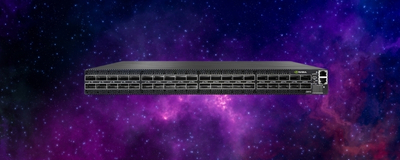
| Part Number | Chipset Generation | Managed | Ports Configuration | Port Speed | Form Factor | Airflow | Power Supply |
|---|---|---|---|---|---|---|---|
| MSB7800-ES2F | Switch-IB 2 (EDR) | Yes (x86) | 36x QSFP28 | 100Gb/s | 1U Standard | Port-to-Power (P2C) | Dual AC PSU |
| MSB7890-ES2R | Switch-IB 2 (EDR) | No | 36x QSFP28 | 100Gb/s | 1U Standard | Power-to-Port (C2P) | Dual AC PSU |
| MQM8700-HS2F | Quantum (HDR) | Yes (x86) | 40x QSFP56 | 200Gb/s | 1U Standard | Port-to-Power (P2C) | Dual AC PSU |
| MQM8790-HS2F | Quantum (HDR) | No | 40x QSFP56 | 200Gb/s | 1U Standard | Port-to-Power (P2C) | Dual AC PSU |
| MQM9700-NS2F | Quantum 2 (NDR) | Yes | 32x OSFP (64x NDR ports) | 400Gb/s (OSFP) | 1U Standard | Port-to-Power (P2C) | Dual AC PSU |
| MQM9790-NS2F | Quantum 2 (NDR) | No | 32x OSFP (64x NDR ports) | 400Gb/s (OSFP) | 1U Standard | Port-to-Power (P2C) | Dual AC PSU |
InfiniBand Generations Comparison#
| Generation | Chipset | Max Port Speed | Switch Capacity | Signaling Rate / Modulation | Latency |
|---|---|---|---|---|---|
| EDR | Switch-IB 2 | 100 Gb/s | 7.2 Tb/s | 25 Gb/s NRZ | 90 ns |
| HDR | Quantum | 200 Gb/s | 16.0 Tb/s | 50 Gb/s PAM4 | 130 ns |
| NDR | Quantum 2 | 400 Gb/s (800G ready) | 51.2 Tb/s | 100 Gb/s PAM4 | 205 ns |
InfiniBand Network Topology Guide#
Building a scale-out cluster for AI training or physics simulation requires specialized topologies:
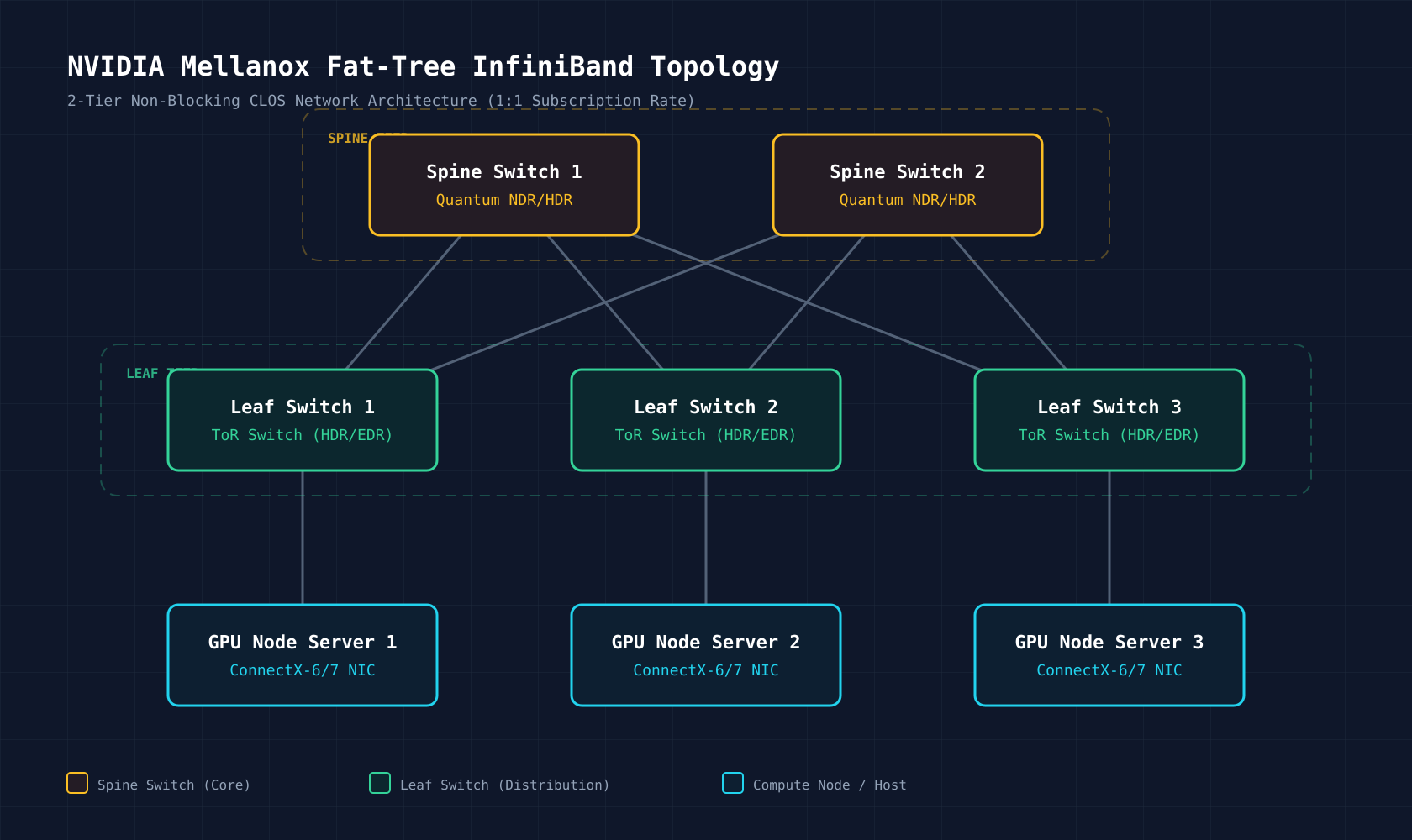
1. Fat-Tree (non-blocking CLOS) Topology#
The standard architecture for InfiniBand networks. It organizes switches in hierarchical tiers (Leaf and Spine) to provide multiple parallel paths.
- Non-blocking (1:1 subscription): Every node can communicate at full wire speed concurrently. Requires equal uplink bandwidth to the spine as downlink bandwidth to the nodes.
- Over-subscribed (e.g., 2:1): Lowers switch costs by reducing the number of spine links, suitable for workloads with localized compute communication.
2. Rail-Optimized AI Networks#
In multi-GPU nodes (like NVIDIA HGX H100 with 8 GPUs), each GPU has a dedicated ConnectX NIC. Rail-optimization connects all “GPU 1” adapters across all servers to a dedicated “Rail Switch 1,” all “GPU 2” to “Rail Switch 2,” and so on. This maps the ring-communication pattern of deep learning libraries (NCCL) directly onto physical switches, minimizing latency.
Managed vs Unmanaged Switches & Subnet Manager (SM)#
Unlike Ethernet networks which are plug-and-play via ARP, an InfiniBand network cannot pass traffic without an active Subnet Manager (SM). The SM discovers topology, assigns Local Identifiers (LIDs), and calculates routing paths.
- Managed Switches: Feature an internal CPU running MLNX-OS/Onyx that hosts an embedded Subnet Manager. Ideal for standalone small clusters (up to ~36 nodes).
- Unmanaged Switches: Staggeringly low-latency, but have no onboard CPU. They require an external SM running either on a host server (via OpenSM) or on a separate managed switch within the fabric.