- Yopitek Ltd/
- Blog/
- ALFA AWUS036ACH Driver Install Guide for China: Kali Linux, Ubuntu, Debian & Raspberry Pi/
ALFA AWUS036ACH Driver Install Guide for China: Kali Linux, Ubuntu, Debian & Raspberry Pi
Table of Contents
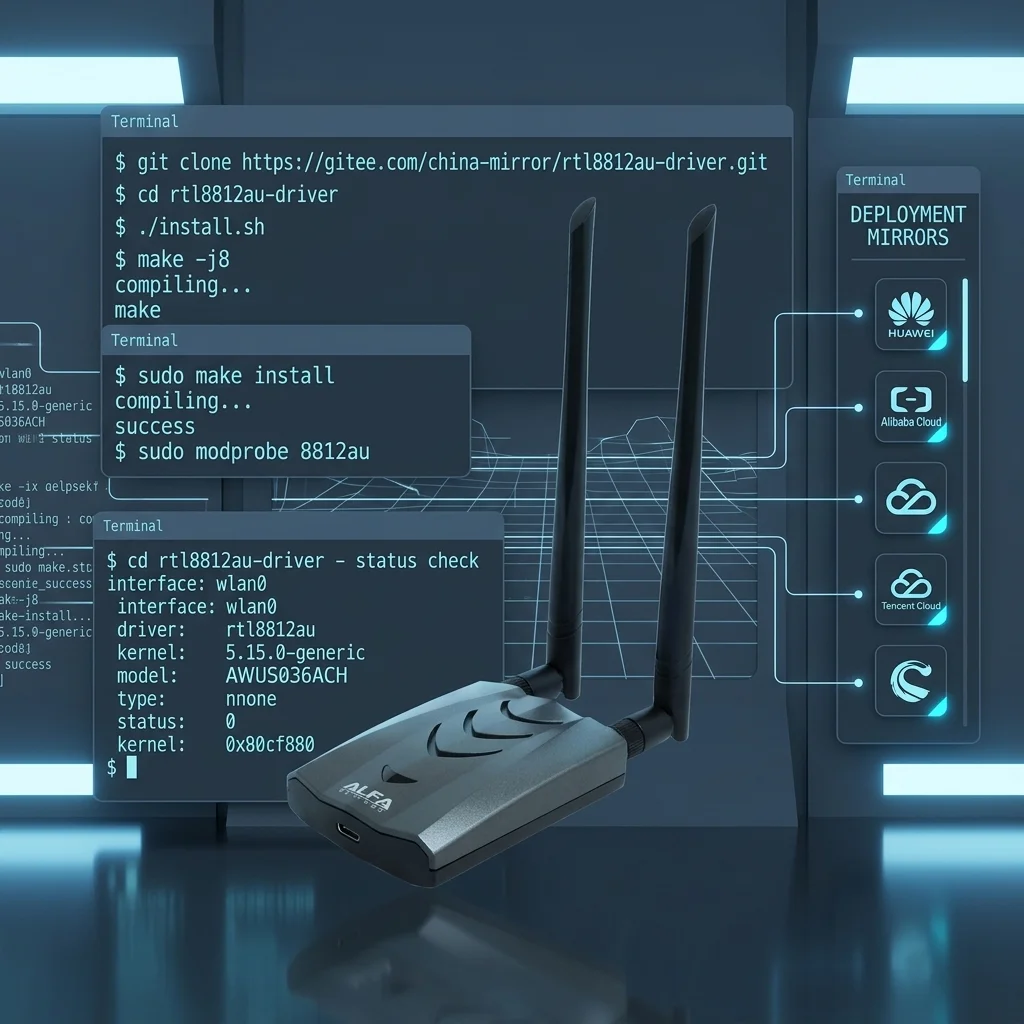
You just got the AWUS036ACH and your Linux machine doesn’t recognize it. That’s normal — this chip needs the RTL8812AU driver, and it’s not plug-and-play. This guide walks you through the full install in about 30 minutes, using only domestic mirrors. No GitHub access needed.
Make sure you have these ready:
Before You Start#
Make sure you have these ready:
- ALFA AWUS036ACH adapter
- USB cable (the one that came in the box works fine)
- A powered USB hub — required if you’re on Raspberry Pi
- Active internet connection to reach domestic mirrors
Plug in the adapter, then confirm your system sees it:
lsusbLook for this in the output:
Bus 001 Device 003: ID 0bda:8812 Realtek Semiconductor Corp.If you see 0bda:8812, the adapter is detected. Move to your OS section below.
If you don’t see it, try a different USB port or swap the cable, then run lsusb again.
Choose Your Operating System#
Jump to the right section for your OS:
Already installed? Skip to:
Kali Linux#
Kali comes with strong wireless tooling built in. Getting the AWUS036ACH driver running takes four steps. Start by switching to a fast Chinese mirror so every download stays quick.
Step 1: Switch to China Mirror#
Open your sources list in the terminal.
sudo nano /etc/apt/sources.listDelete whatever is there, then paste this line:
deb http://mirrors.ustc.edu.cn/kali kali-rolling main contrib non-free non-free-firmwareSave the file: press Ctrl+O, then Enter, then Ctrl+X to exit. Refresh the package index.
sudo apt updateBackup mirror: If 中科大 (USTC) is slow on your connection, use 清华 (Tsinghua) instead:
deb https://mirrors.tuna.tsinghua.edu.cn/kali kali-rolling main contrib non-free non-free-firmware
Step 2: Install the Driver#
Kali’s package repository includes a prebuilt DKMS driver. Install it with one command.
sudo apt install -y realtek-rtl88xxau-dkmsDKMS automatically recompiles the driver whenever your kernel updates, so you will not need to reinstall manually after an upgrade.
Verify the driver loaded correctly.
modinfo 88XXau | grep -E "filename|version"You should see a filename line ending in .ko and a version line showing a version string like 5.6.4.2. If both appear, the driver is ready.
Step 2 (Alternative): Manual Compile from Source#
Only follow this section if the apt install above failed. First install the build dependencies.
sudo apt install -y git dkms build-essential libelf-dev linux-headers-$(uname -r)Download the driver source from Gitee.
git clone https://gitee.com/mirrors/rtl8812au.gitNOTE: If that URL does not load, search Gitee for
rtl8812auand pick the most recently updated fork. You can also download a source archive directly from files.alfa.com.tw.
Move into the cloned directory, then compile and install.
make
sudo make install
sudo dkms add .
sudo dkms install rtl8812au/$(cat VERSION)
Load the driver into the running kernel.
sudo modprobe 88XXauStep 3: Enable Monitor Mode#
Before putting the adapter into monitor mode, check which interface name your system assigned it.
iwconfigLook for a wlan0 or wlan1 entry. Use that name in the commands below.
Stop NetworkManager and wpa_supplicant — both fight over the adapter and will block monitor mode.
sudo airmon-ng check kill
sudo airmon-ng start wlan0
Confirm the switch worked.
iwconfigLook for an entry like wlan0mon with Mode:Monitor. When you see that, the adapter is ready for packet capture.
Step 4: Test Packet Injection#
Run the injection test against the monitor interface.
sudo aireplay-ng --test wlan0monA successful result looks like this:
Trying broadcast probe requests...
Injection is working!
Found 1 AP
If the test fails, reboot the machine and run the test again. If it still fails after a reboot, confirm no other process holds the interface — run iwconfig and make sure only wlan0mon appears, with nothing else claiming the adapter.
Ubuntu 22.04 / 24.04#
Ubuntu splits into two branches with different package file formats. The steps below handle both. Use 阿里云 (Aliyun) as your mirror — it’s fast, reliable, and maintained by Alibaba.
Step 1: Switch to China Mirror#
Pick your Ubuntu version and follow that path only.
Ubuntu 24.04 (Noble)#
Open the new DEB822-format sources file:
sudo nano /etc/apt/sources.list.d/ubuntu.sourcesDelete everything in the file and paste this exact content:
Types: deb
URIs: http://mirrors.aliyun.com/ubuntu/
Suites: noble noble-updates noble-security
Components: main restricted universe multiverse
Signed-By: /usr/share/keyrings/ubuntu-archive-keyring.gpg
Save with Ctrl+O, then exit with Ctrl+X.
Ubuntu 22.04 (Jammy)#
Open the classic sources file instead:
sudo nano /etc/apt/sources.listReplace all existing lines with:
deb http://mirrors.aliyun.com/ubuntu/ jammy main restricted universe multiverse
deb http://mirrors.aliyun.com/ubuntu/ jammy-updates main restricted universe multiverse
deb http://mirrors.aliyun.com/ubuntu/ jammy-security main restricted universe multiverse
Save and exit the same way (Ctrl+O, then Ctrl+X).
Refresh the package index#
Run this for both versions after editing your sources file:
sudo apt updateStep 2: Install Build Dependencies#
The driver compiles from source, so you need the kernel headers and build tools first:
sudo apt install -y git dkms build-essential libelf-dev linux-headers-$(uname -r)This pulls in gcc, make, and the exact headers that match your running kernel. The $(uname -r) part auto-detects your kernel version — no need to type it manually.
Step 3: Download Driver Source (China Mirror)#
Clone the driver repository from Gitee, which is accessible inside China:
git clone https://gitee.com/mirrors/rtl8812au.gitThen move into the cloned folder:
cd rtl8812auNote: If that URL times out or returns a 404, go to gitee.com and search for
rtl8812au. Pick the fork with the most recent commit date.
Step 4: Compile and Install#
Build the kernel module from source:
makeInstall it into the system:
sudo make installRegister the module with DKMS so it survives kernel upgrades:
sudo dkms add .
sudo dkms install rtl8812au/$(cat VERSION)
Load the module into the running kernel:
sudo modprobe 88XXauVerify the module loaded correctly:
modinfo 88XXau | grep filenameYou should see a path ending in 88XXau.ko or similar. If the command returns output, the driver is active.
Step 5: Enable Monitor Mode#
First, kill any processes that might interfere with the wireless interface:
sudo airmon-ng check killThen put the adapter into monitor mode:
sudo airmon-ng start wlan0Note: Your interface may be named
wlan1instead ofwlan0. Runiwconfigfirst to see all wireless interfaces listed, then substitute the correct name in the command above.
Step 6: Test Packet Injection#
With the adapter in monitor mode, run the injection test:
sudo aireplay-ng --test wlan0monA successful result shows lines like Injection is working!. If you see errors about the interface, double-check that monitor mode is active with iwconfig wlan0mon.
Debian#
Debian’s package manager points to overseas servers by default. Switching to 清华大学 (Tsinghua University) mirror brings download speeds from overseas crawl to local sprint.
Step 1: Switch to China Mirror#
Open the sources list:
sudo nano /etc/apt/sources.listDelete everything inside and paste these three lines (Debian 12 Bookworm):
deb https://mirrors.tuna.tsinghua.edu.cn/debian/ bookworm main contrib non-free non-free-firmware
deb https://mirrors.tuna.tsinghua.edu.cn/debian/ bookworm-updates main contrib non-free non-free-firmware
deb https://mirrors.tuna.tsinghua.edu.cn/debian-security bookworm-security main contrib non-free non-free-firmware
Save with Ctrl+O, then exit with Ctrl+X. Refresh the package index:
sudo apt updateStep 2: Install Build Dependencies#
The AWUS036ACH driver compiles from source, so you need the kernel headers and build tools:
sudo apt install -y git dkms build-essential libelf-dev linux-headers-$(uname -r)This command tailors the header package to your running kernel version automatically.
Step 3: Download Driver Source (China Mirror)#
Clone the driver repository from Gitee:
git clone https://gitee.com/mirrors/rtl8812au.gitMove into the project folder:
cd rtl8812auCan’t reach that URL? Search Gitee for
rtl8812auand pick the most recently updated fork.
Step 4: Compile and Install#
Run these commands in sequence inside the rtl8812au folder:
make
sudo make install
sudo dkms add .
sudo dkms install rtl8812au/$(cat VERSION)
sudo modprobe 88XXau
dkms registers the driver so it survives kernel updates automatically.
Step 5: Enable Monitor Mode#
Kill interfering processes before switching modes:
sudo airmon-ng check killStart monitor mode on your adapter:
sudo airmon-ng start wlan0If airmon-ng is missing, install it first:
sudo apt install -y aircrack-ngConfirm the interface came up:
iwconfigLook for an interface named wlan0mon in the output.
Step 6: Test Packet Injection#
sudo aireplay-ng --test wlan0monA stream of injection test results confirms the adapter works. You’re ready to go.
Raspberry Pi 4B / 5#
The AWUS036ACH draws ~500mW. Plugging it directly into a Raspberry Pi USB port can cause the Pi to throttle or restart under load. Always use a powered USB hub.
Step 1: Download Kali Linux ARM64 Image#
Go to the official Kali ARM downloads page: https://www.kali.org/get-kali/#kali-arm
Pick Raspberry Pi 4 (64-bit) or Raspberry Pi 5 (64-bit) to match your board. Do not download the 32-bit image — the driver build requires a 64-bit kernel.
China mirror: If kali.org loads slowly, try 华为云 instead: https://repo.huaweicloud.com/kali-images/ Browse to the latest release folder and download the same ARM64 image from there.
Step 2: Flash to MicroSD#
Insert your microSD card, then check its device path before writing anything.
lsblkFind your card in the list — it will show as something like sdb or mmcblk0. Then flash the image, replacing /dev/sdX with your actual path.
# Replace /dev/sdX with your actual SD card (check with lsblk)
sudo dd if=kali-linux-2025.1-raspberry-pi-arm64.img of=/dev/sdX bs=4M status=progress conv=fsync
sync
Wait for sync to finish before pulling the card. Boot the Pi from the card. Default credentials after boot: kali / kali.
Step 3: Switch to China Mirror#
After first boot, open the package sources file.
sudo nano /etc/apt/sources.listDelete everything in the file and replace it with this single line:
deb http://mirrors.ustc.edu.cn/kali kali-rolling main contrib non-free non-free-firmwareSave: press Ctrl+O, then Enter, then Ctrl+X. Now apply the mirror and upgrade the system.
sudo apt update && sudo apt full-upgrade -y
sudo reboot
The reboot picks up any kernel updates before you install the driver.
Step 4: Install Driver (ARM64)#
The DKMS package works on ARM64 exactly the same as x86 — no special steps needed.
sudo apt install -y realtek-rtl88xxau-dkmsIf that command returns an error saying the package is not found, compile the driver from source instead.
sudo apt install -y git dkms build-essential libelf-dev linux-headers-$(uname -r)
git clone https://gitee.com/mirrors/rtl8812au.git
cd rtl8812au
make
sudo make install
sudo dkms add .
sudo dkms install rtl8812au/$(cat VERSION)
sudo modprobe 88XXau
Step 5: Enable Monitor Mode#
Before touching the adapter, check which interface name the Pi assigned it.
iwconfigOn a Pi with a built-in Wi-Fi chip, the AWUS036ACH shows up as wlan1 — the built-in radio takes wlan0. Use whatever name iwconfig reported above.
sudo airmon-ng check kill
sudo airmon-ng start wlan1
Run iwconfig again and look for an entry ending in mon — wlan1mon in the typical Pi case — with Mode:Monitor. That confirms the adapter switched successfully.
Step 6: Test Packet Injection#
sudo aireplay-ng --test wlan1monReplace wlan1mon with whatever monitor interface name appeared in Step 5. A working adapter prints Injection is working!. If the test fails, reboot and try once more. A bad USB connection through an unpowered hub is the most common cause on Pi — double-check you are using the powered hub.
Virtual Machine USB Passthrough#
Running Kali Linux inside a VM on macOS or Windows? You need to pass the USB adapter through to the guest OS.
VirtualBox#
- With the VM powered off, go to Settings → USB.
- Enable USB 3.0 (xHCI) Controller.
- Click the + icon to add a USB filter.
- Select: Realtek 802.11ac NIC […] (ID: 0bda:8812).
- Start the VM — the adapter appears inside Kali.
Inside the VM, run lsusb to confirm 0bda:8812 appears, then follow the Kali Linux steps above.
VMware Fusion (macOS) / VMware Workstation (Windows)#
- Start the VM.
- In the menu: Virtual Machine → USB & Bluetooth.
- Find Realtek 802.11ac NIC and click Connect.
- The adapter disconnects from the host and appears inside the VM.
Run lsusb inside the VM to confirm, then follow the Kali Linux steps above.
A Note on VIF (Virtual Interface)#
The RTL8812AU chip in the AWUS036ACH has limited VIF support on Linux. You cannot reliably run managed mode and monitor mode (or AP mode) at the same time on the same adapter.
If your workflow needs VIF — for example, running fake APs while monitoring simultaneously — the AWUS036ACH is the wrong tool. Check the AWUS036ACM install guide instead. That adapter uses the MT7612U chip, which has full kernel-native VIF support and handles simultaneous virtual interfaces without patches.
常見問題
What chipset does AWUS036ACH use? Does it need extra drivers?
AWUS036ACH uses the Realtek RTL8812AU chipset. The driver is not built into the Linux kernel and needs manual installation.
Do I need a VPN to install AWUS036ACH drivers in China?
No. You can complete the entire process using domestic mirrors like USTC, Aliyun, and Gitee source code mirrors.
Does AWUS036ACH support monitor mode and packet injection?
Yes. After installing the RTL8812AU driver, use airmon-ng to enable monitor mode and aireplay-ng to test packet injection.
Can AWUS036ACH work on a Raspberry Pi?
Yes. Use a powered USB hub and flash the Kali ARM64 image for best results.
What is the Kali Linux command to install AWUS036ACH drivers?
Run sudo apt install realtek-rtl88xxau-dkms to install the pre-compiled driver on Kali.
Troubleshooting#
| Problem | Likely Cause | Fix |
|---|---|---|
lsusb doesn’t show 0bda:8812 | Adapter not powered or bad cable | Try a different USB port. Use a powered hub on Raspberry Pi. |
make fails with header errors | Kernel headers missing or version mismatch | Run sudo apt install linux-headers-$(uname -r) |
modprobe 88XXau fails | Secure Boot blocking unsigned modules | Disable Secure Boot in BIOS, or sign the module |
| Driver disappears after kernel update | Driver not registered with DKMS | Re-run sudo dkms install rtl8812au/$(cat VERSION) from the source directory |
airmon-ng start wlan0 fails | NetworkManager still running | Run sudo airmon-ng check kill first |
| Monitor mode starts but captures no traffic | Wrong channel or wrong interface name | Check interface with iwconfig. Set channel: iwconfig wlan0mon channel 6 |
| Injection test says “No Answer” | AP too far away, or using wrong interface | Move closer to the AP. Use wlan0mon not wlan0 |
China Mirror Reference#
All resources used in this guide — no GitHub required:
| Resource | URL | Use for |
|---|---|---|
| Alfa official drivers | files.alfa.com.tw | Driver packages, firmware |
| Alfa documentation | wiki.alfa.com.tw | Product manuals |
| 清华大学镜像 | mirrors.tuna.tsinghua.edu.cn | Kali / Debian / Ubuntu |
| 阿里云镜像 | mirrors.aliyun.com | Ubuntu (recommended) |
| 中科大镜像 | mirrors.ustc.edu.cn | Kali (recommended) |
| 华为云镜像 | repo.huaweicloud.com | Kali ARM images (backup) |
| RTL8812AU driver (Gitee) | gitee.com/mirrors/rtl8812au | Manual compile fallback |
More Alfa Adapter Guides for China#
This is part of the Alfa China Install Guide series. Each article covers one adapter model:
- AWUS036ACH ← you are here
- AWUS036ACM China Install Guide — MT7612U, best VIF support
- AWUS036ACS China Install Guide
- AWUS036AX China Install Guide
- AWUS036AXER China Install Guide
- AWUS036AXM China Install Guide
- AWUS036AXML China Install Guide
- AWUS036EAC China Install Guide
Questions? Leave a comment below or contact us at yupitek.com.